Nick Fudge
127.8 x 167.6 cm


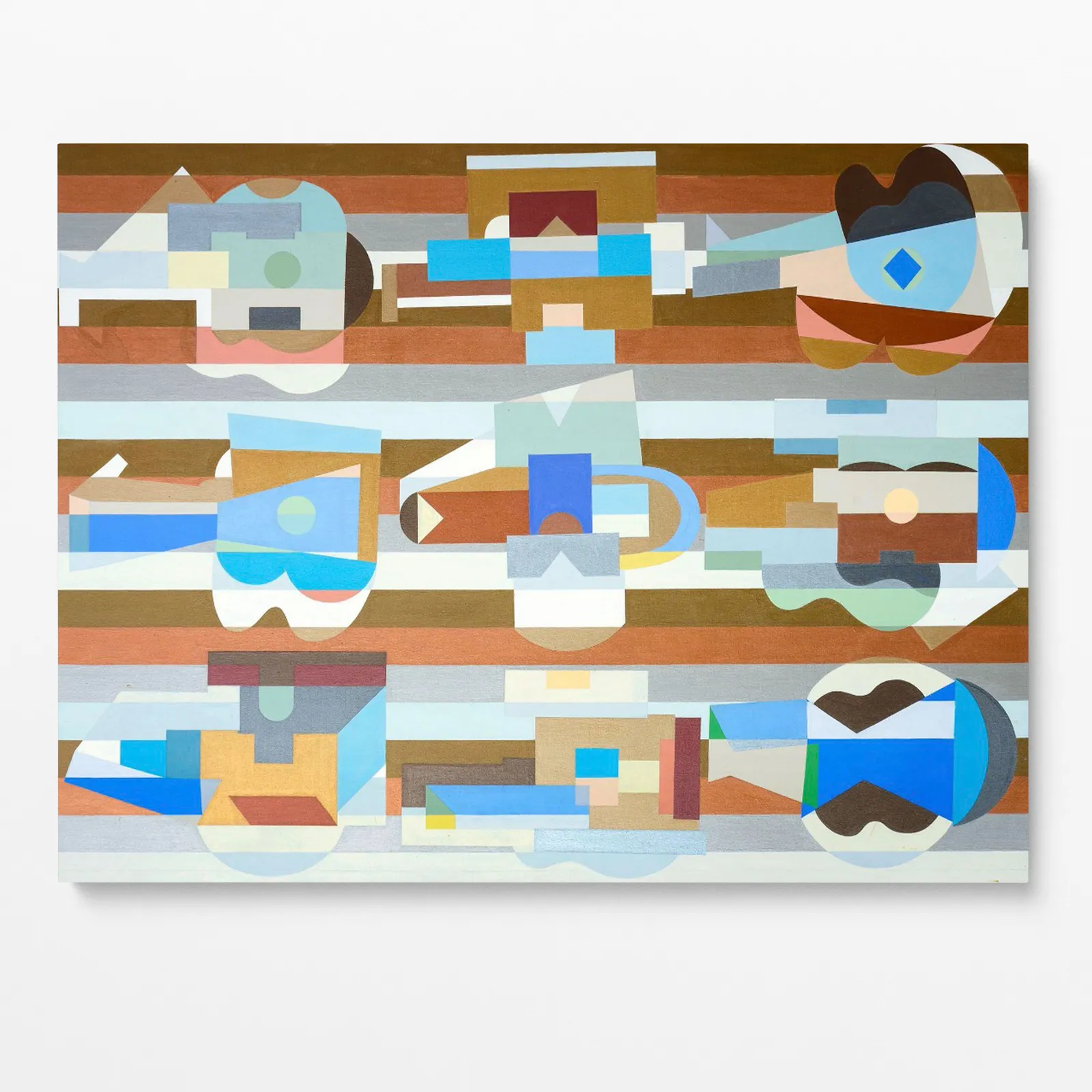
Nick Fudge’s Cubist Pure Data extends his ongoing inquiry into the afterlife of modernism by reframing Cubism through the language of digital systems. Where early Cubism fractured objects in order to reassemble perception, Fudge reorganizes its grammar into something flatter, cleaner, and algorithmically precise. The result is a painting that feels less like an analytic still life and more like a dataset.
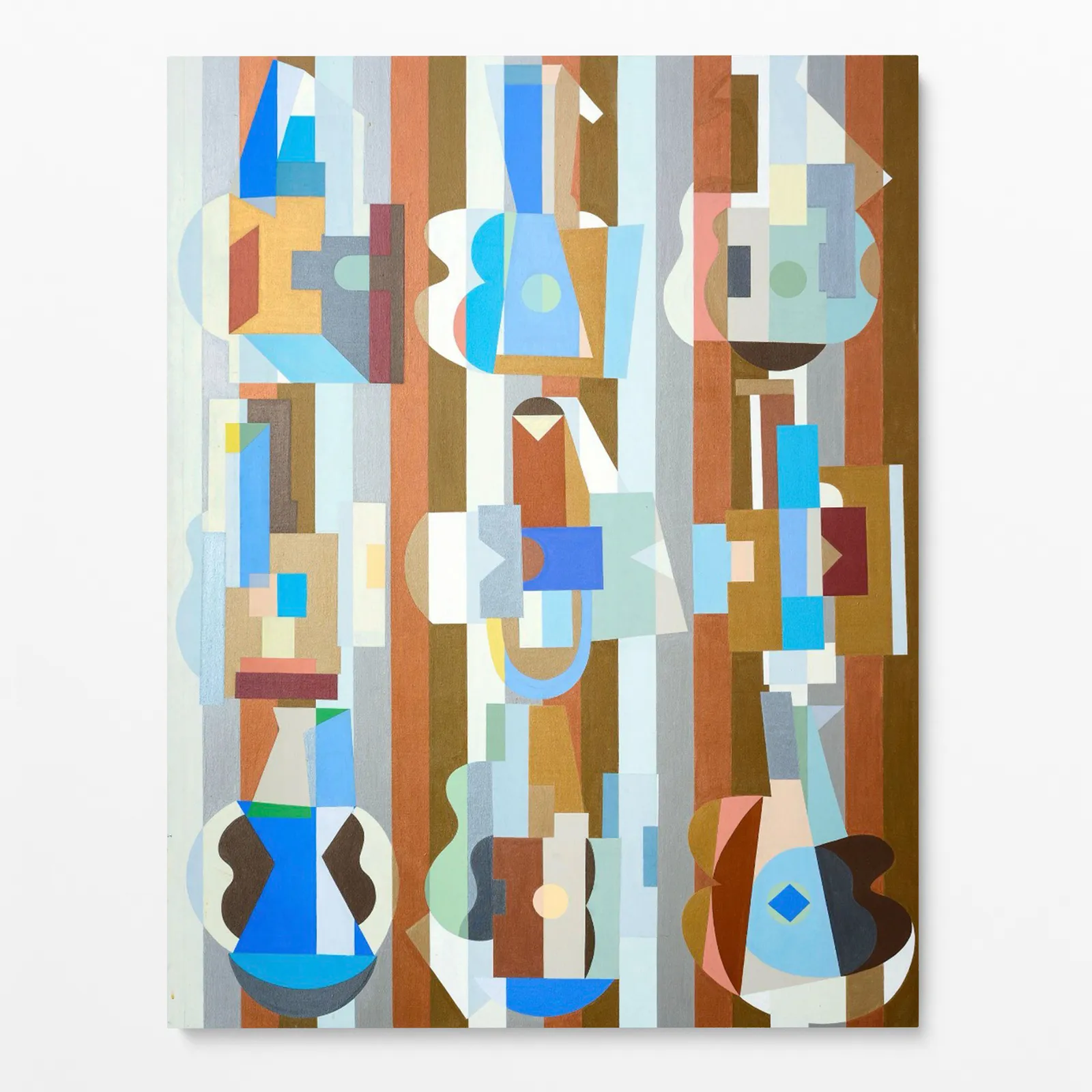
The composition unfolds horizontally in rhythmic bands of muted ochres, rusts, pale blues, and greys. Across these stripes, geometric units including curved arcs, truncated cylinders, rectangular blocks, and circular cut-outs float in serial formations. Each cluster suggests the residue of Cubist motifs: a bottle, a guitar, a café table, a human profile. Yet none fully coalesces into representation. Forms are simplified to the point of schematic abstraction, as though translated from hand-drawn fragmentation into vector-based code. The brushwork is smooth and controlled; color fields are crisply contained. The tactile collage sensibility of early Cubism has been replaced by a calibrated, near-digital finish.
The title, Cubist Pure Data, is telling. “Pure Data” evokes not only abstraction but the computational logic of stripped information. In this sense, Fudge’s painting imagines Cubism not as a revolutionary rupture but as a precursor to data visualization. Picasso and Braque once dissected objects to reveal multiple viewpoints; Fudge dissects Cubism itself, rendering its visual vocabulary into modular components that behave like code blocks within a grid.
The horizontal structure intensifies this reading. Rather than the oval containment device used by early Cubists to stabilize pictorial space, the painting stretches outward laterally, like a scrolling interface. The repetition of bands suggests bandwidth or signal transmission. Forms appear to migrate across these stripes, as though transmitted through layers of compression and reassembly. What once was a guitar becomes a curved data node; a café glass becomes a translucent disc; a human face dissolves into a composite of geometric tokens.
Color plays a crucial role in this recalibration. Fudge’s palette avoids the dramatic chiaroscuro and textured surfaces of early 20th-century Cubism. Instead, he opts for softened industrial hues that feel simultaneously modernist and post-digital.
Conceptually, Cubist Pure Data positions modernism within a recursive loop of production and reproduction. If Cubism once dismantled Renaissance perspective, Fudge dismantles Cubism into informational units. The painting suggests that what we now inherit from modernism is less its revolutionary fervor than its transferable syntax: its shapes, its compositional logic, its brand-like recognizability. In a culture defined by infinite digital replication and algorithmic sorting, the avant-garde gesture becomes both archive and template.
Yet Fudge’s treatment is neither cynical nor nostalgic. There remains a subtle lyricism in the interplay of curves and rectangles, a gentle humor in the almost-recognizable faces and objects embedded within the grid. The painting oscillates between homage and cool detachment, between historical reference and computational abstraction. In doing so, Cubist Pure Data proposes that the legacy of Cubism now lives less in fractured bottles and café tables than in the structural logic of how we process, compress, and circulate images today.
Ultimately, the work reframes Cubism as a proto-digital language: an early experiment in modular vision that anticipated our current condition of endless recombination. What remains is a painting that reads like a quiet interface between past and present, where the hand of modernism meets the syntax of data.