I Love Your Work: Rob Ventura & Loren Eiferman

I Love Your Work proposes artistic admiration as an active and generative force.
Kelly-McKenna Gallery, in partnership with Space Gallery St Barth, is pleased to present I Love Your Work, a two-person exhibition featuring paintings by Rob Ventura and sculptures by Loren Eiferman. The exhibition will be on view from September 10 through October 25, 2026, at Space Gallery St Barth’s New York City gallery, located at 428 Broome Street between Crosby and Lafayette Streets.
Bringing Ventura’s richly layered paintings into conversation with Eiferman’s intricate wooden sculptures, I Love Your Work considers the role that admiration, affinity, and creative exchange play in an artist’s practice. Although Ventura and Eiferman developed their respective bodies of work independently, each recognized in the other a shared fascination with organic systems, invented natural forms, and the underlying structures that connect living things.
The exhibition’s title reflects the directness and generosity of that recognition. “I love your work” is both an expression of admiration and an acknowledgment of artistic kinship. This exchange belongs to a long history of artists whose practices were sharpened through mutual observation, admiration, competition, and dialogue. In the twentieth century, artists such as Pablo Picasso and Henri Matisse each developed distinctive identities while remaining acutely aware of the work being produced around them. Their relationship demonstrate that influence does not diminish originality; rather, the encounter with another artist’s vision can clarify, challenge, and expand one’s own.
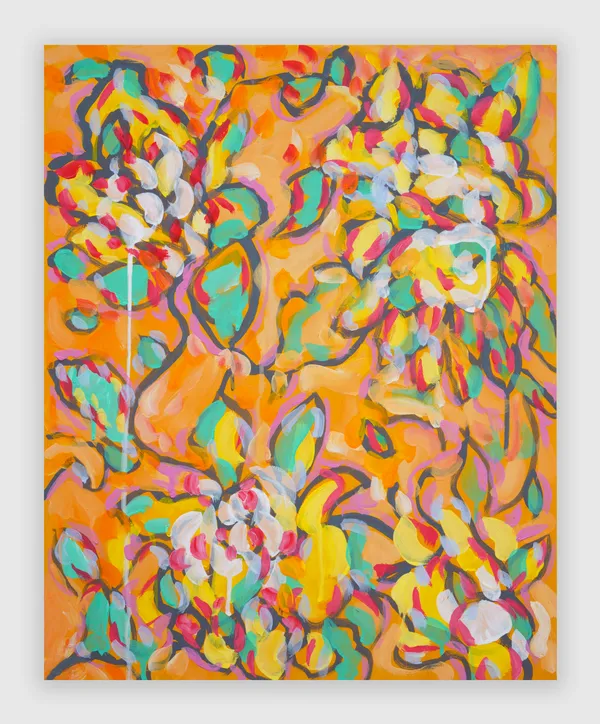
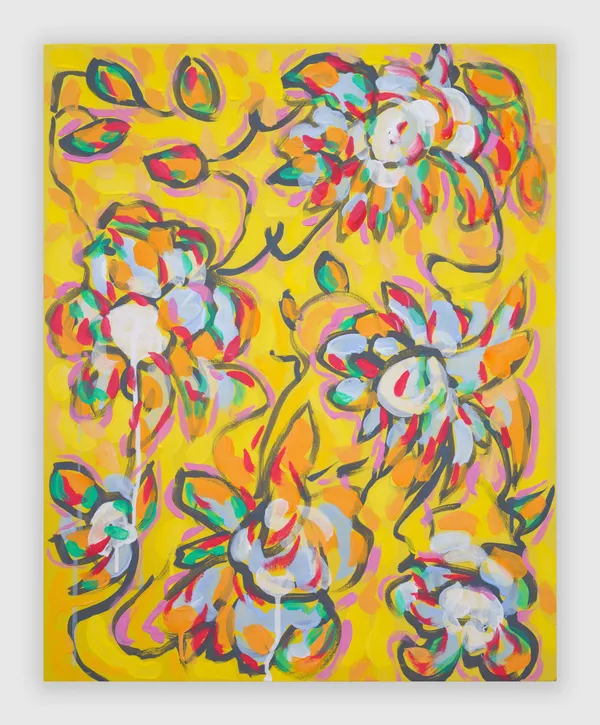
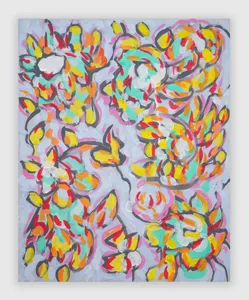
Ventura’s paintings combine organic, emotive forms with compositional structures informed by the golden ratio. Drawing from flowers, fauna, microbes, cells, fungi, butterflies, insects, honeycombs, and animal patterns, he creates dense arrangements of color, texture, and recurring motifs. His imagery moves fluidly between the microscopic and the cosmic, suggesting that the smallest biological structure may contain the logic of a much larger universe. Across his practice, Ventura explores the interconnectedness of living systems and the mystery embedded within natural order.
Eiferman approaches sculpture as a form of three-dimensional drawing. Her winding biomorphic structures are assembled from hundreds of individual sections of foraged tree limbs, which she meticulously joins, fills, and sands until their seams disappear. The resulting sculptures appear to form a single continuous line moving through space. Although constructed through an exacting process, the works seem to have grown autonomously, resembling specimens from an imagined botanical world rather than representations of existing plants.
Seen together, Ventura’s paintings and Eiferman’s sculptures appear to emerge from a related ecosystem. Both artists begin with close attention to the natural world but resist straightforward representation. Ventura transforms biological references into patterned, psychologically charged fields, while Eiferman reorganizes fragments of actual trees into impossible organisms. Their works hover between observation and invention, the recognizable and the unknown.
The dialogue between two and three dimensions is central to the exhibition. Ventura’s painted forms appear to proliferate, overlap, and press outward from the picture plane, while Eiferman’s sculptures extend drawing into physical space. Lines become branches; patterns suggest cellular networks; and repeated units accumulate into larger structures. In both practices, complexity arises through connection.
I Love Your Work proposes artistic admiration as an active and generative force. Rather than presenting influence as a linear exchange, the exhibition considers the more subtle experience of discovering that another artist has been independently asking similar questions. Ventura and Eiferman share an interest in how individual fragments become unified systems, how natural structures balance order and unpredictability, and how invented forms can feel uncannily alive.
Installed in close conversation, the works invite viewers to move between surface and structure, image and object, microscopic detail and expansive form. A pattern within one of Ventura’s paintings may find an echo in the branching rhythm of an Eiferman sculpture; a wooden contour may appear to continue a painted line across the gallery. These correspondences reveal not imitation, but resonance: two distinct practices connected by a shared sensitivity to the intelligence, strangeness, and beauty of the natural world.


-
 Loren Eiferman, 25r/Summer Into Spring, 2026
 -
Loren Eiferman, Breath (for Evie), 2007
-
Loren Eiferman, Life Interrupted (for Spalding), 2004
-
Loren Eiferman, Lunaria, 2024


-
Loren Eiferman, Rust Never Sleeps, 2008
-
Loren Eiferman, Seed Pod, 2023
-
Loren Eiferman, The Gathering, 2026
-
Loren Eiferman, Voynich #1, 2015


-
Rob Ventura, Camellias II, 2025
-
Rob Ventura, Camellias III, 2026
-
Rob Ventura, Camellias IV, 2026
-
Rob Ventura, Chrysanthemum I, 2026


-
Rob Ventura, Cosmos bipinnatus I, 2026
-
Rob Ventura, Cosmos bipinnatus II, 2026
-
Rob Ventura, Cosmos bipinnatus III, 2026
-
Rob Ventura, Cosmos bipinnatus V, 2026

-
Rob Ventura, Cosmos bipinnatus VI, 2026
-
Rob Ventura, Cosmos bipinnatus VII, 2026
-
Rob Ventura, Cosmos bipinnatus VIII, 2026
-
Rob Ventura, Honeycomb IX, 2024


